Activities
Coin Exhibition
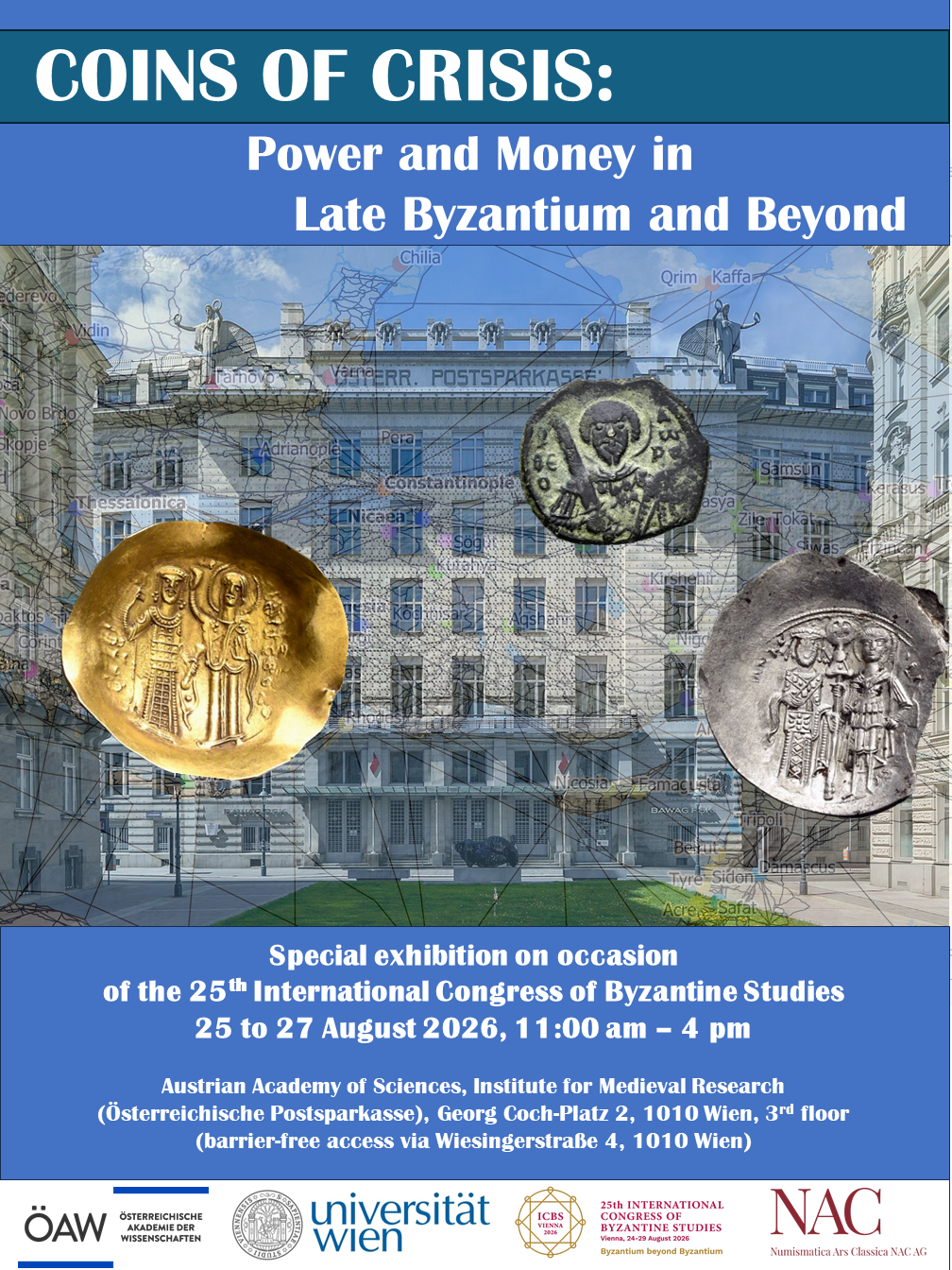
Coins of Crisis: Power and Money in Late Byzantium and Beyond
Coin exhibition on occasion of the 25th International Congress of Byzantine Studies in Vienna
Opening hours: 25 to 27 August 2026, 11 am – 4 pm
Venue: Austrian Academy of Sciences, Institute for Medieval Research (Österreichische Postsparkasse), Georg Coch-Platz 2, 1010 Wien, 3rd floor (barrier-free access via Wiesingerstraße 4, 1010 Wien)
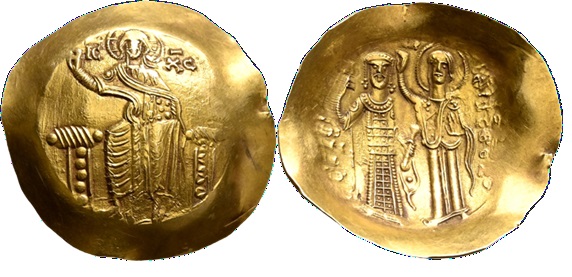
For centuries, the Eastern Roman (Byzantine) Empire was not only the most venerable polity in Europe, but also issued the most prestigious coinage of the Mediterranean, the golden solidus (later called nomisma or hyperpyron) with a weight of 4.55 gram. Despite all geopolitical and economic challenges, Byzantium was able to maintain its currency at a more or less stable value for more than 700 years up until the 11th century; scholarship in the 1950s therefore called the Byzantine gold coin the “Dollar of the Middle Ages” (which in the meantime, however, has proven much less stable than the Byzantine currency…).
The first severe crisis of Byzantium´s currency in the 11th century overlapped with a period of territorial contraction and the rise of new geopolitical and economic competitors. The empire was able to stabilize its borders, economy and coinage once more in the 12th century, but eventually a combination of internal conflicts and external attacks led to its collapse with the conquest of the capital of Constantinople by the Crusaders and Venetians in 1204. Although some members of the Byzantine elites were able to maintain power in territories in Western Greece, at the Black Sea and in Northwestern Asia Minor – from where Constantinople was reconquered in 1261 – the empire was never able to regain a similarly central position in politics and trade as before.
In contrast, the Eastern Mediterranean and Black Sea were dominated by new superpowers such as the Mongol states of the Golden Horde in Eastern Europe and of the Ilkhanate in the Near East or the Mamluk Sultanate in Egypt and Syria, while the former core regions of Byzantium in Southeastern Europe and Anatolia were characterized by territorial fragmentation. Within this diverse political landscape, commercial connectivity was provided by the merchants of the maritime republics of Venice, Genoa or Pisa, which in turn competed for the control of trade routes and colonial outposts in the Aegean or on the Crimea.
All these actors issued their own coinage, and the political fragmentation and cultural diversity of the Eastern Mediterranean after the Fourth Crusade in 1204 was also reflected in a plurality of currencies. In this exhibition, coins from Late Byzantium and neighboring polities are not only presented as means of payment, but equally as media of power and artefacts of socioeconomic entanglements – reflecting the innovative research of the young collector of these specimens, Samuel Ernest Logan Cowell, a PhD-student at the University of Vienna (on the supervision of the numismatist Nikolaus Schindel and the Byzantinist Johannes Preiser-Kapeller).
The exhibition is co-organized by the team of the research project “Entangled Charters of Anatolia (1200-1300, ENCHANT)” funded by the Austrian Science Fund FWF at the Institute for Medieval Research of the Austrian Academy of Sciences (https://www.oeaw.ac.at/en/imafo/research/byzantine-research/byzantium-and-beyond/mobility-and-intercultural-contacts/entangled-charters-of-anatolia-1200-1300-enchant) and was accompanied by a course at the University of Vienna in the summer term of 2026 (https://ufind.univie.ac.at/en/course.html?lv=070088&semester=2026S). Hence, in addition to the coins from the collection of Sam Cowell, the exhibition will also display results of ENCHANT and other projects as well as projects of students of the University of Vienna illustrating the wider framework of global commerce and mobility in the late medieval period within and beyond Byzantium.
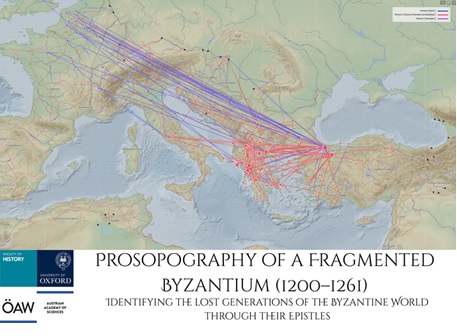
Prosopography of a Fragmented Byzantium: 1204–1261 is an early-stage initiative by Nathan D.C. Websdale (University of Oxford), in collaboration with Ekaterini Mitsiou (University of Vienna), as a means of addressing one of the more substantial gaps remaining in Byzantine prosopographical studies – the political fragmentation of the Balkan peninsula following the arrival of the Fourth Crusade in 1204. The sack of the capital, and the five-decade period that follows, is the infamous dismantling of a centralised Byzantine state based in Constantinople. Conversely, that period is also a time of survival and rebuilding of administrative, judicial, familial, and social networks. Within that milieu there is an often-unrecognised flourishing of the epistolary tradition, the art of letter-writing, which connected the peoples of the fragments of Byzantium and which gained an almost unprecedented importance in the thirteenth century. The initiative will also be on display with a poster.
Deep Diving into Rome & Byzantium
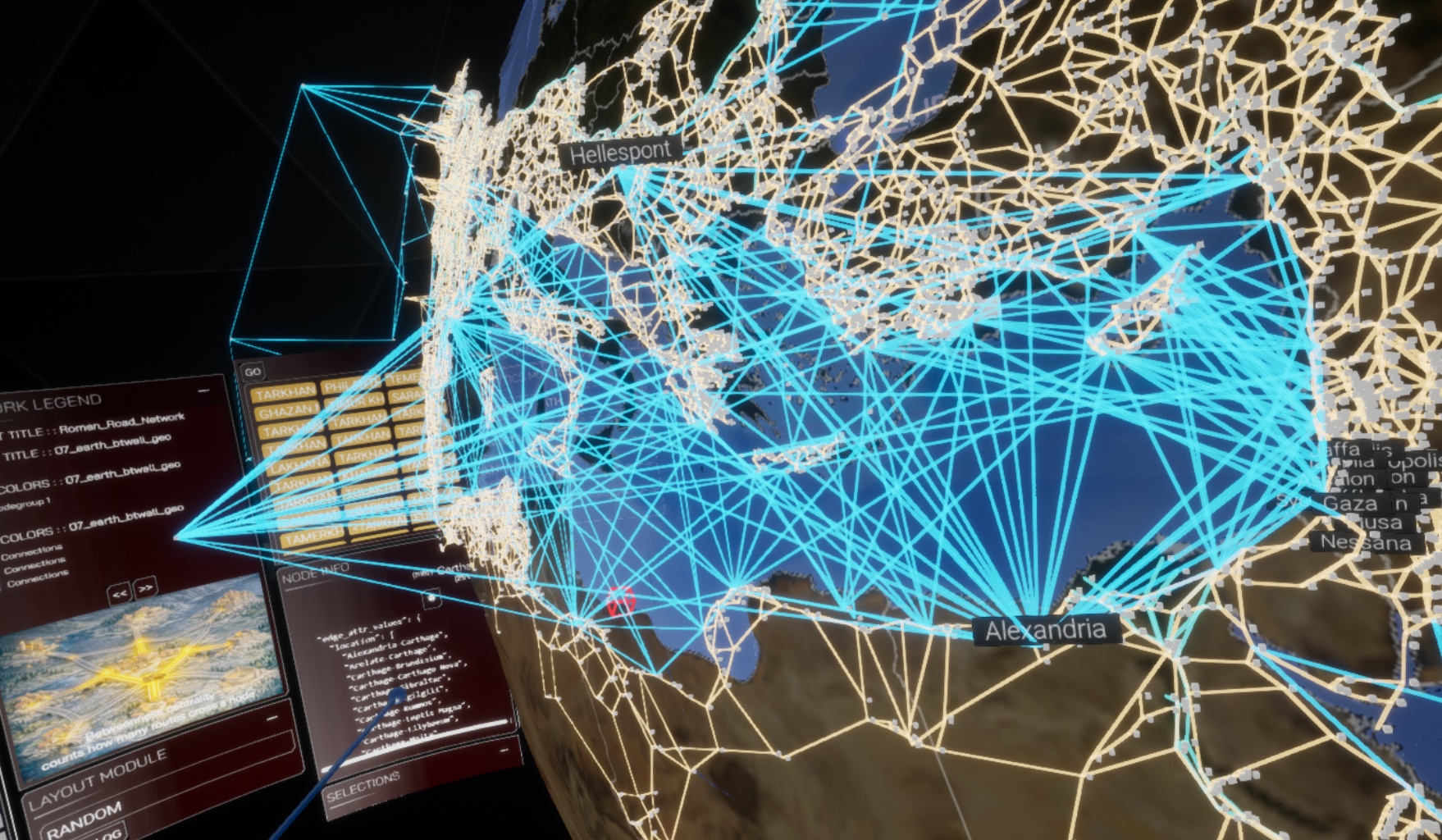
Furthermore, visitors will have the unique opportunity to explore Roman and Byzantine History in four dimensions in Virtual Reality. In a cooperation of the Institute for Medieval Research (IMAFO) of the Austrian Academy of Sciences with the Ludwig Boltzmann Institute for Network Medicine at the University of Vienna, networks of Roman and Byzantine routes and of the Late Byzantine Elite have been processed and visualised in a totally new way. Within a setup at the venue of the Coin Exhibition, congress participants and all interested visitors can dive into the complex entanglements of the Roman and Byzantine World and travel through geographical and social spaces over several centuries. Data scientist Felix Müller will be present on Tuesday and Wednesday from 1 to 4 pm as your guide through these virtual spaces and its technical background. The data was prepared and analysed by the ENCHANT-project team at IMAFO.
The exhibition is only possible due to the generous support of Numismatica Ars Classica, represented by Mr. Giuliano Russo. Founded in Zurich in 1988, Numismatica Ars Classica made its debut with its first auction in the following year. The standard and quality of the coins offered in the few years that followed soon gained the company a reputation as one of the world’s leading and most trusted firms for ancient coins. NAC’s specialist areas are primarily, but not limited to, Greek, Roman, Byzantine and Italian coins. NAC participates in all major numismatic auctions and is a member of all the principal numismatic associations. NAC strongly believes in the importance of numismatic research and is the proud sponsor of numismatic initiatives to preserve the tradition of coin collecting and encourage new enthusiasts to the field (see https://www.arsclassicacoins.com/).